How environmentally friendly is carbon fiber? The answer is uncomfortable: it depends on the entire life cycle, not merely the material’s light weight.
Carbon fiber can reduce vehicle mass and lower fuel or battery energy use during operation. However, producing one kilogram requires substantial heat, electricity, and chemical processing. The International Energy Agency identifies energy-intensive industrial production as a major emissions challenge. Life-cycle studies published in the Journal of Cleaner Production commonly estimate carbon-fiber production at roughly 20–40 kilograms of CO2-equivalent per kilogram, depending on the precursor, factory energy mix, and manufacturing route. Some assessments report even higher figures.
The manufacturing stage matters most.
Dr. Vlastimil Kunc, a composite-manufacturing expert at Oak Ridge National Laboratory, has emphasized a practical principle: “We need to consider the whole life cycle of the composite.” That perspective supports findings from the European Commission’s Joint Research Centre and the U.S. Department of Energy’s lightweight-materials research. Recycling remains difficult because most carbon-fiber composites combine fibers with permanent thermoset resins. Mechanical recycling can shorten fibers. Pyrolysis can recover fibers, but usually with reduced strength and additional energy use.
Carbon fiber is not automatically environmentally friendly. Its benefits may appear during use, while its environmental debt begins at production. A long-lasting aircraft component may justify that debt. A short-lived consumer product may not. The comparison is rarely simple.
The evidence is still incomplete.
Different factories produce different results, and recycled fiber data remain inconsistent. Any credible assessment should disclose energy sources, service life, repairability, and end-of-life treatment. Otherwise, “lightweight” can become a convenient label rather than a complete environmental claim.
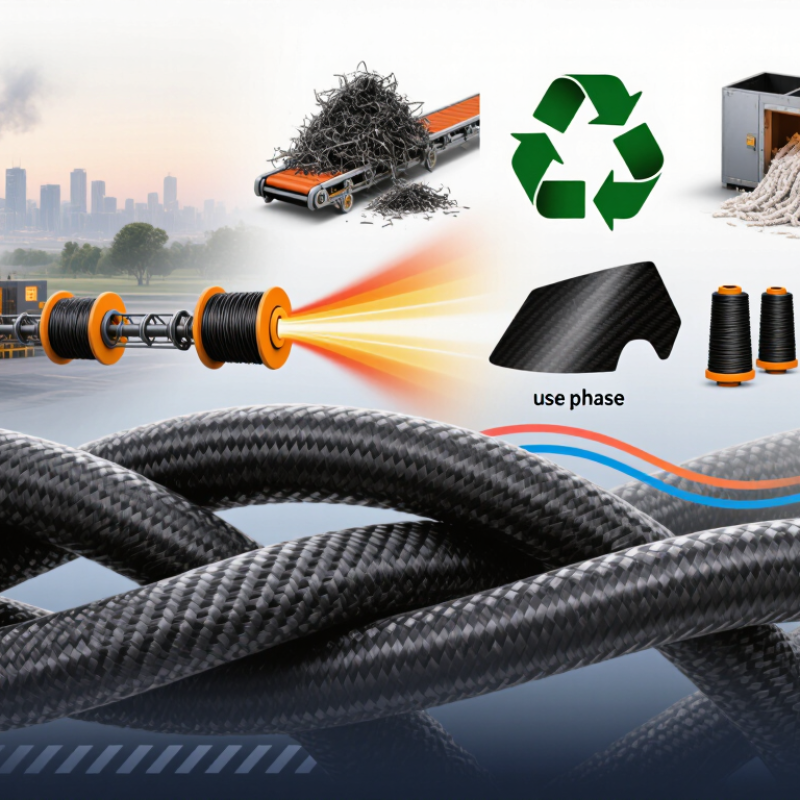
Carbon fiber is a material made from extremely thin carbon filaments. These filaments are woven into sheets and combined with a resin. The result is a light, stiff composite with impressive tensile strength. It also resists corrosion better than many metals. In practice, this means engineers can build lighter frames, panels, sporting equipment, and transport components. Less weight can improve handling and reduce energy use during operation.
Its popularity has a difficult side. Producing carbon fiber requires intense heat, careful processing, and substantial energy. The resin also binds the fibers tightly, making repair and recycling complicated. Many common composites cannot be separated easily after use. Their production emissions may outweigh operational savings, especially when a product has a short service life. I have seen carbon fiber praised as “efficient,” but that description is incomplete. Durability helps, yet manufacturing still carries a heavy environmental cost. Recycling methods are improving, though they are not perfect.
Tips: Check the product’s expected lifespan before choosing carbon fiber. Ask whether damaged parts can be repaired or recycled. Use only the material needed for the design. Compare its full life cycle, not just its weight. A lighter product is not automatically a greener product.
| Data Dimension | Typical or Reported Data | Why Carbon Fiber Is Widely Used | Environmental Consideration |
|---|---|---|---|
| Material composition | Carbon fibers are generally composed of about 90–95% carbon by mass. They are commonly embedded in a polymer matrix to form carbon-fiber-reinforced polymer. | The fibers provide high strength and stiffness, while the polymer matrix holds the fibers in position and transfers loads. | The combination of carbon fibers and thermoset polymers makes separation and complete material recovery difficult. |
| Density | Approximately 1.75–2.00 g/cm³ for carbon fibers, depending on fiber grade and structure. | Carbon fiber is much lighter than steel, whose density is approximately 7.85 g/cm³. | Lower weight can reduce energy use during the operating life of vehicles and aircraft, but this benefit must be balanced against energy-intensive manufacturing. |
| Specific tensile strength | Typical commercial carbon fibers have tensile strengths of roughly 3–7 GPa, depending on grade and processing. | High strength relative to weight allows designers to reduce structural mass while maintaining load-bearing performance. | The performance advantage can lower use-phase impacts, but it does not eliminate the environmental impacts of producing the fibers and resin. |
| Specific stiffness | The elastic modulus of many carbon fibers is approximately 200–700 GPa, depending on fiber type. | High stiffness helps limit deformation and supports lightweight structures with precise dimensional requirements. | High-performance grades generally require more demanding processing, which can increase energy and resource requirements. |
| Main precursor | Most carbon fiber is produced from polyacrylonitrile, commonly abbreviated as PAN. Some grades use pitch-based precursors. | Different precursor routes allow manufacturers to tailor strength, stiffness, electrical conductivity, and cost. | Precursor production depends on petrochemical or fossil-derived feedstocks in many supply chains. |
| Manufacturing stages | Typical production includes precursor spinning, stabilization in air, carbonization at high temperature, and optional graphitization or surface treatment. | These controlled thermal steps create the desired fiber structure and performance. | Stabilization and carbonization require substantial heat, making production energy-intensive and potentially carbon-intensive when fossil-based electricity or fuels are used. |
| Energy demand | Published life-cycle studies commonly identify carbon-fiber production as energy-intensive; reported values vary significantly with precursor, process efficiency, plant scale, and energy mix. | The energy-intensive process is justified in applications where weight reduction produces substantial operational savings. | High manufacturing energy can create a large initial carbon footprint before the product is used. |
| Common applications | Aerospace structures, wind-turbine components, pressure vessels, sporting goods, automotive parts, marine structures, and civil-engineering reinforcement. | The material combines low weight, high strength, high stiffness, corrosion resistance, and good fatigue performance. | Environmental benefits depend on the application, service life, maintenance requirements, and whether the weight reduction offsets production impacts. |
| Corrosion resistance | Carbon fibers do not rust like steel and can retain performance in many chemically aggressive environments. | Long service life and reduced corrosion maintenance are valuable in transport, marine, and infrastructure applications. | Long durability can reduce replacement impacts, but the material remains difficult to repair, disassemble, and recycle at end of life. |
| Recyclability | Mechanical recycling, thermal recycling, and chemical recovery can recover fibers, but recovered fibers may be shorter, weaker, or less aligned than virgin fibers. | Recycled fibers can be suitable for selected semi-structural or non-structural products. | Recycling infrastructure is less established than conventional metal-recycling systems, and thermoset composites cannot simply be remelted and reshaped. |
| End-of-life challenge | Composite parts often contain tightly bonded fibers, resin, coatings, adhesives, and other materials. | The strong bond improves structural reliability during use. | The same bond complicates separation and can result in landfill disposal or energy-intensive recovery processes. |
| Overall environmental profile | Carbon fiber is not inherently environmentally friendly or environmentally harmful in every application; its impact depends on the full life cycle. | It is most beneficial where lightweighting, durability, and energy savings during use are substantial. | Key concerns include high production energy, fossil-derived feedstocks, resin dependence, limited recycling, and difficult end-of-life management. |
Note: Values are typical ranges reported for commercial carbon fibers and can vary with precursor type, fiber grade, manufacturing process, and application.
Manufacturers heat polymer fibers through stabilization and carbonization. Carbonization often exceeds 1,000°C. Furnaces may run continuously for hours.
A cleaner power grid can lower production emissions. Fossil-fuel-based electricity usually increases them. The factory location matters.
No. Reduced weight may lower fuel use during years of operation. That saving may not erase production emissions.
Many products use cured thermoset resin. It cannot simply melt and flow again. The materials remain tightly bonded.
Machines may grind frames or panels into fillers. This process shortens fibers and reduces their strength. The result often suits lower-performance uses.
Thermal recycling removes resin but may damage fibers. Chemical recycling can preserve more quality. It requires solvents, energy, and careful separation.
Estimates place it near 183–286 megajoules per kilogram. The figure changes with the process and precursor. Data varies.
Usually, recycled fiber needs less production energy. Collection, sorting, and processing can reduce that advantage. The benefit is not guaranteed.
Detachable joints, clearer labels, and thermoplastic matrices may help. Products could also use less material and last longer. Some changes may reduce manufacturing efficiency.
Carbon fiber is a lightweight, exceptionally strong material widely used in transportation, sports equipment, construction, and other demanding applications. Its strength-to-weight ratio can improve efficiency and reduce the amount of material needed in some products. However, understanding how environmentally friendly is carbon fiber requires examining its entire life cycle. Producing the material requires energy-intensive processes and can generate significant emissions, especially when high temperatures and complex chemical treatments are involved.
Carbon fiber products are also difficult to recycle because they often combine fibers with strong resin systems and other materials. Recycling can weaken the fibers, require specialized equipment, and cost more than producing new material. As a result, discarded products may be sent to landfills or incinerated, increasing waste and losing valuable resources. Researchers are exploring lower-energy manufacturing methods, recyclable or renewable resins, improved recovery technologies, and alternative materials. These developments may reduce carbon fiber’s environmental impact, but broader progress will depend on cleaner energy, better product design, and effective recycling systems.

 RAXIS Fiber